
Your broker shows you six trades. It was one position.
Strikelens links every assignment and roll into one chain with one adjusted cost basis, then shows you the numbers that say whether the strategy is working, next to the notes on whether you followed your own plan.
A wrong cost basis makes every decision after it wrong.
Assignment, four rolls, a call-away. Your broker files that as six unrelated line items with a basis that means nothing, so you build a spreadsheet. Then the spreadsheet becomes a second job: a cost basis that drifted, FIFO lots allocated by hand, and a journal in a different file. Strikelens is the move off that sheet. The chain stays linked and one running basis is correct.
From a covered call to an iron condor, in one picker
Cash-secured puts sit next to calendars, condors, and ratio spreads. Book what you trade today, and keep the same books when the structure grows a second strike.
- Covered calls, cash-secured puts, and the wheel
- Verticals, calendars, and diagonals
- Iron condors, butterflies, and ratio spreads
- Custom when the legs are your own
Every wheel cycle, treated as one run
A cash-secured put that gets assigned, a covered call sold against the shares, and the eventual close or call-away: one row per cycle, with the premium each step credited and the basis it left behind.
- Every put-to-shares-to-call cycle as one row
- Stage: selling puts, holding, covered call, or closed
- Premium collected, realized P&L, adjusted basis
- Waterfall of how each leg added up
The wheel and rolls, linked into one chain
Assignment, every roll, and the eventual close or call-away: one position with one adjusted cost basis, not a pile of disconnected trades.
- Automatic roll-chain linking
- FIFO lot tracking on assignments and closes
- Server-calculated realized + unrealized P&L
- Adjusted cost basis across the wheel
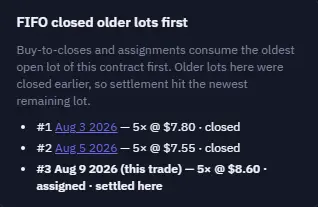
FIFO lots, not a spreadsheet column you hope is right
Buy-to-closes and assignments consume the oldest open lot of that contract first. Older lots that were already closed are skipped, so settlement can land on a newer remaining lot, and the trade view shows which one.
- Oldest open lot consumed first
- See which lot an assignment actually hit
- No hand-maintained FIFO column
A dashboard built around expectancy, not just P&L
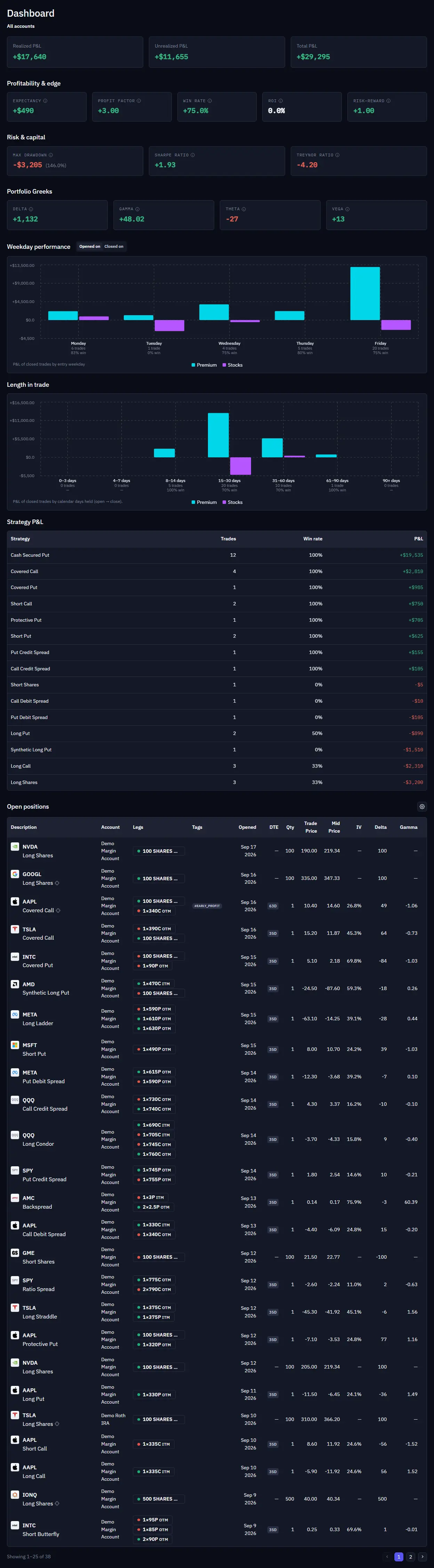
Win rate, profit factor, expectancy, Sharpe, drawdown, and portfolio Greeks: the numbers that tell you whether your edge is real.
- Expectancy and profit factor
- Portfolio Greeks
- Sharpe ratio and drawdown
An expiry calendar that actually helps you plan
Every open position plotted against its expiry, month, week, or year view, color-coded by strategy.
Premium vs. stock performance, side by side
Weekly premium collected and a monthly premium-vs-stocks scatter, benchmarked against SPY and QQQ, with a cost-of-emotion view for the trades that broke plan.
A journal that sits next to the numbers
Notes, #tags, psych fields, and plan compliance on every trade, so you can see whether you followed your own rules.
Connect a broker, sync automatically
Link Schwab, Fidelity, E*TRADE, Interactive Brokers, and more through SnapTrade. Positions and trade history sync on their own, no exports to remember.
- Auto-connect for major brokers
- Trades and positions sync automatically
- Read-only: Strikelens cannot place a trade or move a dollar
Or import your trade history
CSV import for the brokers options sellers actually use: Tastytrade, Robinhood, Fidelity, E*TRADE, Alpaca, and Trading 212.
Supported brokers:
 Alpaca
 E*TRADE
 Fidelity
 Robinhood
 Tastytrade
 Trading 212
How it works
From first login to real numbers in a few minutes.
Sign up free
No card required. Create an account and add your first trading account.
Import or connect
Upload a broker CSV (or the spreadsheet you already keep), connect read-only via SnapTrade, or enter trades manually.
See your real P&L
Rolls link into wheel chains automatically. Cost basis, Greeks, and edge metrics update server-side.
Free to start. It's not a demo.
One account and manual entry, free, with roll chains and wheel cycles included. Unlimited accounts and CSV import on Pro. Automatic broker sync on Ultra.
View pricingFrequently asked questions
Straight answers, including the honest ones.